by Gerry Bixley Since 1921 the usual Dennis chassis used for large passenger vehicles was a 4 Ton or 15 ft 10 in wheelbase type.This wheelbase was specially designed for the purpose, shorter vehicles were available for non bus use.The 4 Ton had a 115 mm x 150 mm 5.7 litre petrol engine of White and Poppe design and manufacture then priced at £125.00. This was the ‘C ’ type.W &P had supplied engines from their Coventry factory for many years and Dennis purchased the company in 1919.
The 4 Ton type had straight top frames, high off the ground, and was suitable for lorries and, at the time, buses. It was claimed to be suitable for single or double deck bodies and indeed many customers took advantage of this, sometimes changing body types on any one particular chassis as years went by. For double deck purposes this meant a very high vehicle and almost all were open topped. In London, the NS type had started the trend to have a lower floor level by a slight reduction of the frame height between the wheelbase. Leyland took note of this which resulted in their TD Titan double deck range with a more pronounced lowering of the frame top height within the wheelbase. This was followed by their single deck TS Tiger type. Dennis was a major supplier of bus chassis at this time and saw the trend, realising their 4 Ton type was becoming dated. A lower floor-line single deck chassis was quickly designed and in December 1925 the first 'E' chassis appeared powered by the White and Poppe 5.7 litre engine as used in the 4 Ton type. This would be a 16ft 0 in wheel base chassis and was to have a production run of 616. The White and Poppe engine list consisted of sequential numbers of all types so a small engine would have a number next to an entirely different type. The final 4 Ton chassis had engines numbered 20xxx and were produced after the 'E' type had been in production for over a year.
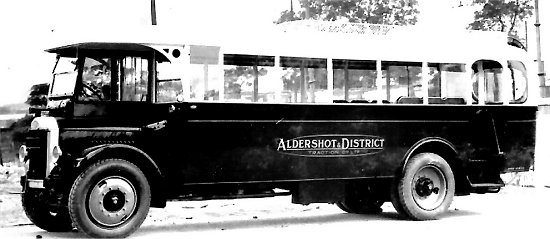
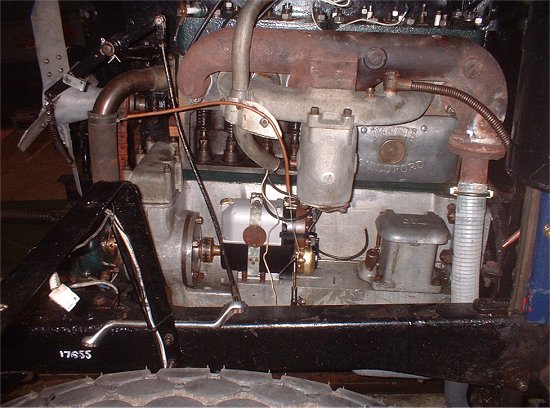
The first 250 or so 'E' type chassis had the 20xxx series engines and the remainder had an updated 'D' type of engine numbered in 50xxx services, the first of which powered an Aldershot and District Dennis 'E'. The 'E' chassis was of forward control (almost semi-forward control) as the dash and controls were set some distance to the rear of the front of the chassis frame. Handbrake and gearchanges were to the driver's right. The engine, a 'C' later 'D' type of 5.7 litres had the petrol tank positioned to it's rear, transversely across the chassis. A short propshaft (about 2ft 3in long) connected the power unit with a centrally placed 4 speed gearbox. Attached to the gearbox was what is described as a brake servo, driven off the clutch, which assisted the driver's foot pedal. This servo consisted as a series of levers and was made by or under licence from Rolls Royce. Only rear wheel brakes were normal until the 'E' type was introduced but an innovation was 4 wheel brakes. A demonstration using a Dennis 'E' convinced the Metropolitan Police to withdraw their opposition to this feature. All the brake linkage was by rods and levers. There were 6 steel outriggers attached to each side of the chassis frame as an aid for attaching the body structure. There were 3 choices of pneumatic tyres. The available bodyspace was 20 ft 0 ¾ in. The first 'D' series engines were fitted to the 'E' type from December 1927. The last numbered 'E' was chassis 17616.
Chassis 17617 onwards were known as The 'ES' type of which 100 were produced all powered by the recently introduced 'D' engine. A number of publications about Dennis have identified the S suffix to refer to the six cylinder engine but the Dennis engine registers confirm this was not true. Two Dennis drawings were produced of the 'ES', one with the fuel tank behind the engine and the other having a fuel tank slung beside the offside chassis rail. The 'ES' design may have come from the fact that the type had a small vacuum servo fitted to the offside chassis rail to the rear of the driver's compartment. This was a standard location for this type of equipment on many makes of vehicle. The Rolls Royce mechanical servo was not used after this. The general chassis layout of the 'ES' was similar to the 'E' but the 'ES' had a 16 ft 6 in wheelbase and a resultant available body space of 20 ft 4¾ in. When bodied it was not obvious whether a vehicle was an 'E' or an 'ES', although many had offside underslung fuel tanks. The last 'ES ', No. 17716 was produced in July 1929, just less than 4 years after the first 'E'.
Dennis decided on a further upgrade of the 'E' concept and in November 1929 a successor type emerged as the 'EV'. The first chassis No. 17800 is shown as going to White and Poppe, perhaps as an experimental machine. The overall chassis dimensions were the same as the 'ES' but the available body space was increased to 21ft 3in with a side petrol tank, a similar dimension to an 'ES' with that same feature. However, the front end was totally redesigned with a new chromed more rectangular radiator in place of the former rounded style. The cab dash was moved forward to the front of the chassis frame which enabled the driver's seat, and steering wheel to be moved forward in a more upright style. As a result there could be a full width bulkhead to the rear of the bonnet. A peculiarity with the 'ES' when equipped with a side petrol tank was that the driver's cab had to be some 10in [the tank depth] to the rear of the back of the bonnet to allow room for the driver's seat. The nearside front of the passenger saloon could be 10in further forward of this position. Very careful study of photographs of the 'ES' can sometimes pick up this odd feature.
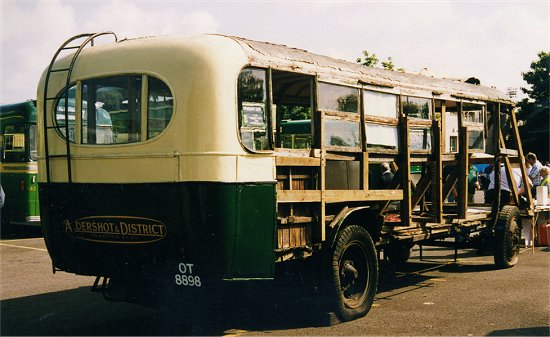
In Sept 1932 the last 'EV's' were produced. However a further 12 Dennis 'E' type (most probably 'ES' lookalikes) were created, not new vehicles as such, in 1931-32. In 1927-28 Aldershot and District bought 12 Dennis 'F' normal control chassis fitted with 28 seat canvas roof coach bodies. A few photographs exist and the extent of their usefulness is not known. After 4 years or so all were withdrawn and their bodies disposed of. 12 new sets of frames of Dennis 'E' type were purchased and most mechanical components were transferred from the withdrawn 'F' chassis. The new chassis were fitted with new 30 seat rear entrance bus bodies with offside petrol tanks. Thus the 10in space behind the bonnet was utilised for the body structure although the cab style was that of an original 1925 design i.e. set well back from the front of the chassis frame. The reconstructed vehicles were classed as new vehicles for valuation purposes and were given new bonnet numbers but curiously retained their original chassis and registration numbers. Some surviving by 1940 were requisitioned for the War Department. This was long after the original 1927-28 vehicles had all been withdrawn. All the vehicles so far described in this article were 4 cylinder type of 5.7 litre capacity as were the similar but double deck vehicles. Half the rebuilt 'F' type had White and Poppe engines and half had the new 'D' type. There was a development of the 'F' type, the 'FS' with vacuum assisted brakes and the later 'D' type engine but only 36 were produced, numbered 80151-80186. The success of the 'E' type was clearly the opportunity to have a double deck equivalent which duly appeared late 1927 as the 'H' type in a series starting at 90000. There were to be 23 of them. The lower level of the main chassis members was similar to the 'E' and produced a chassis height varying between 24½in and 26 ½in, depending on wheel and tyre size. The wheelbase was 16ft 6 11/16in (very precise) and overall length 25ft 0 5/8in. Engines were the 5.7 litre 'D' type, exactly the same as the 'E' range. The appearance was very similar to the 'E', but as with that type the exact form of the radiators were subject to changes as time progressed. The chassis included the mechanical brake servo as of the 1925 'E' design and the petrol tank was positioned at the rear of the bonnet. In December 1928 a varyant appeared as the 'HS' with vacuum sero assisted brakes. The overall length was 25ft 0in but a choice of 7ft 6in or 7ft 2in width
was available. The latter was to comply with London requirements. The similar
set back driver's dash as on the 'E' and 'H' ensured a family appearance.
Chassis numbers ran from 90050 to 90153. The petrol tank was still at the
rear of the bonnet. The final development was in July 1930 when the 'HV'
appeared, an updated 'HS' with driver's dash advanced to the front of the
frames and a squared up radiator appearance. At last the petrol tank was
attached to the main part of the chassis side frames, allowing a more space
saving cab area beside the radiator. The chassis length was advertised at
25ft 0in and not 26ft 0in for some reason. 'HV' chassis were numbered 95000
to 95040, production ceasing after 29th February 1932. However since Sept
1930 a new chassis type was available to catch up with the progress made
by Leyland and AEC passenger ranges. This was the Lance and for once had
a choice of a 4 cylinder or 6 cylinder engine. This followed a similar overlap
of production of the single deck Lancet which was introduced in December
1931 with the last 'EV' not appearing until 9 months later.
|




 Newsletters
Index
Newsletters
Index